III. The Dual Nature of Light
|
A. Light has a dual nature
1.Sometimes it behaves like a particle (called a photon), which explains how light travels in straight lines 2. Sometimes it behaves like a wave, which explains how light bends (or diffracts) around an object 3. Scientists accept the evidence that supports this dual nature of light (even though it intuitively doesn't make sense to us!) |

|
|
B. Quantum Theory
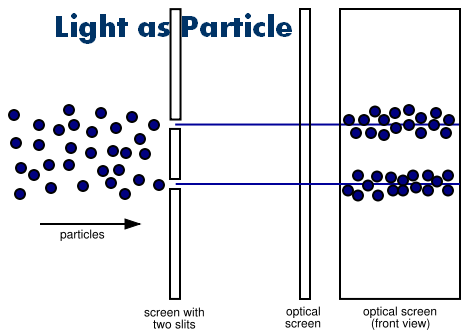
1. Light is thought to consist of tiny bits of energy that behave like particles called photons a. Particles explain how light travels in straight lines or reflects off of mirrors 
|
|
Electromagnetic radiation
1. Light is a form of energy called electromagnetic energy
a. Other types of electromagnetic energy include radio, microwave, heat (infrared), ultraviolet (UV) and X-ray & gamma ray radiation 2. Electromagnetic energy travels in waves |

|
|
3. The waves are different from each other in their lengths – called wavelength
a. Wavelength is the distance between 2 waves b. The crest is the highest point of a wave c. The trough is the lowest point of a wave d. The amplitude is how high the wave is e. Frequency is the number of waves in a given period of time 4. The shorter the wavelength and the greater the frequency, the higher the energy
a. Radio waves are as long as soccer fields, low frequency and low energy b. Gamma rays are smaller than an atom, high frequency and high energy 5. ALL electromagnetic radiation is light, but our eyes can only see a small portion – called visible light
a. Visible light is one millionth of one percent of the entire electromagnetic spectrum i. Consists of several component colors of different wavelengths ii. White light = all the colors of the rainbow added together b. As white light refracts through a prism, the different wavelengths slow down and bend differently, causing them to separate into the colors of the rainbow i. Violet has the shortest wavelength (higher energy) ii. Red has the longest wavelength (lower energy) iii. ROY G. BIV |


|
The Phet interactive below can be helpful in visualizing a wave's amplitude (how high the wave is) and it's frequency (how many waves in a given period. Click on the "oscillate" and the "no end" buttons. Also set "Damping" to none. Increasing the amount of energy in a wave will increase its frequency - much like when we were demonstrating frequency with the jump rope. This interactive is better because with "no end" it is more like the electromagnetic radiation. Note that the wavelength decreases with increasing frequency, so more waves fit into a specific period. With a "fixed end" it's more like our jump rope demonstration.
